
Our charity: Doorstep Support
Doorstep
Support.
Support with dignity, delivered to your doorstep.
- Status
- Ongoing — open for donations
- Appeal
- Church of Christ White Hart Lane
- Registered charity
- No. 1219204
New · Doorstep Support
Food Bank at
White Hart Lane.
A food bank run by Doorstep Support, our charity, in the building where the church meets. Every Sunday from 10am to 1pm, guests are welcomed at the door and collect their food items with a numbered ticket.
- When
- Every Sunday
- Time
- 10am – 1pm
- From
- 17 October 2026
How it works
Come along on a Sunday
Any time between 10am and 1pm, to the Women at the Well Community Centre on White Hart Lane.
Take a guest ticket
You are welcomed at the door and handed a numbered guest ticket.
Collect your food
Use your ticket to collect your food items.
Where
Women at the Well Community CentreUnit 1 Carbery Enterprise Park36 White Hart LaneTottenham, London N17 8DPWho it is for
Homeless people and rough sleepers, single parents and struggling families, people on a low income, children and children with disabilities, and less privileged young people.
Questions
Alongside Women at the Well of Living Waters
The food bank's flyer is shared with Women at the Well of Living Waters, whose community centre hosts it. They run a food hub of their own, twice a week.
Tottenham Lighthouse SDA Food Hub
Tuesdays 11:30am · Saturdays 2pm
Cooked hot meals, hot chocolate, tea and coffee, sandwiches, vintage clothes, shoes and bags.
- Phone
- 07861 449012
- Website
- mwatw.org
- Women At The Well Official
Want to help? See what our goods drive accepts, or how to volunteer.
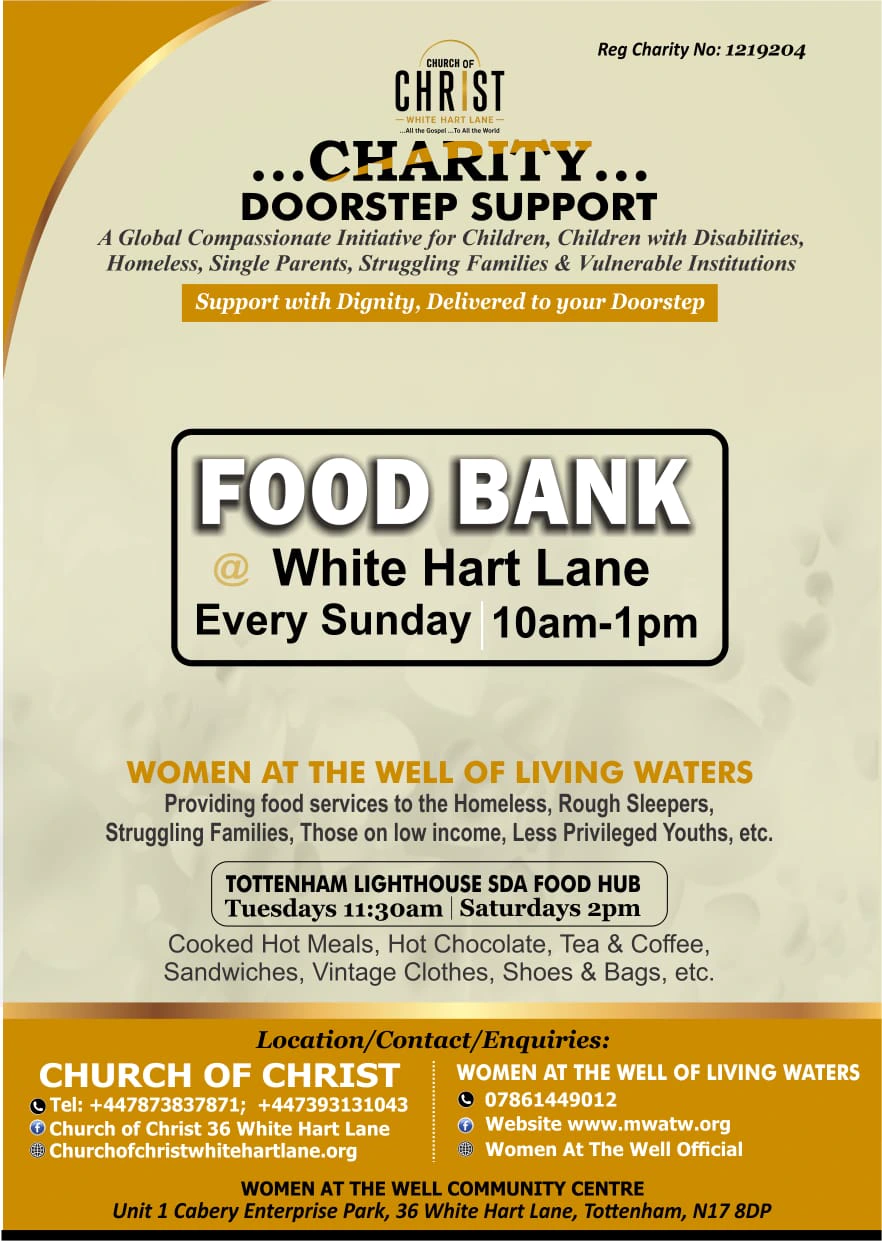 Open the flyer at full size
JPG · 150 KB — for WhatsApp, email or print.
What we do
Dignity,
at the door.
We don't distribute. We support with choice.
Beneficiaries tell us what they need, and Doorstep Support brings it. Where traditional aid decides what you get, asks you to come and queue, and ends at the drop-off, Doorstep Support lets you choose, comes to your door, and comes back.

Doorstep Support Initiative is the community outreach arm of Church of Christ White Hart Lane, a registered charity. It exists for elderly, homeless and vulnerable people, and families in crisis — the people a street can walk past without ever noticing, and the ones who find it hardest to ask.
We restore dignity by delivering beneficiary-chosen essentials to families, care homes, schools, special schools and places of worship. No queues. No shame. No waste.
We believe everyone deserves dignity, care, and hope — right at their doorstep. The appeal is open at the moment and gifts can be made today.
Areas of service
Food and nutrition
The food a household actually eats, chosen from its own Choice Card.
Rice, beans, garri, yam, cooking oil, tinned tomatoes, noodles and cereal; tea, milk and juice; baby food where there is a baby. Nothing generic, nothing a family will not use.
Toiletries and household essentials
The things that run out first and are hardest to ask for.
Soap, detergent and toothpaste; sanitary pads; adult and baby nappies in the right size; wipes, disinfectant and tissue.
Clothing and footwear
By age and by size, for adults and for children.
Clothes, coats, school uniforms and shoes — new, or good as new with the family's consent. Second-hand is never given without that consent, and underwear is never second-hand.
School support
So that a child's schooling does not stop at the household budget.
Exercise books, pens and pencils, a school bag, school shoes.
Medical consumables
Basic first aid and the consumables a household names.
Plasters, paracetamol and vitamins to begin with, and whatever else a family or an institution says it needs.
Emergency relief
When a household is hit by a bereavement, a job loss, a medical emergency or displacement.
The initiative's Rapid Support route uses pre-approved vouchers and partner stores so that help can be at the door within 72 hours.
Who it is for
Families in crisis
Widows, single parents, the unemployed and the displaced.
Care homes
Orphanages, homes for the elderly and hospices.
Schools and special schools
Children with physical or learning challenges, and schools that are underfunded.
Places of worship
Churches, mosques and temples that act as support points for their own communities.
Public gatherings
Camps for displaced people, disability centres and community events for vulnerable groups.
Find the initiative
- Website
- www.churchofchrist.uk
- Donate to Charity
- Church of Christ White Hart Lane
- +44 7873 837871
- Phone
- +44 7393 131043
The Doorstep model
Five phases,
one doorstep.
Where traditional aid decides what you get, asks you to come and queue, and ends at the drop-off, the Doorstep model listens first and comes back afterwards. No queues, no shame, no waste.
Listen
Assessors visit with a Choice Card. No assumptions.
A short visit or call with a family, a care home, a school or a place of worship, and one question: what do you need? The household chooses exactly what it needs from the card — food brands, nappy sizes, clothing by age and gender.
Source
Bought locally, in bulk.
Supplies are bought from local markets in the beneficiary's own area, which cuts the cost and supports the local economy, or drawn from donated goods that match what was chosen.
Pack
Every box to its card, and every box with a note.
Volunteers pack each Support Box to the Choice Card it answers — the exact items, nothing substituted — and tuck in a handwritten note of encouragement or a prayer.
Deliver
Door to door, always in pairs.
Trained teams follow planned Support Routes of eight to twelve stops. Knock, step back, smile, deliver, pray if asked, leave. “This is what you chose,” not “this is what we are giving you.”
Follow up
Seven days later, a call.
A Prayer Partner rings to ask two things: did it meet your need, and how can we support you further? The relationship continues after the box.
Who gets help
The 4-Filter Dignity Framework
So that support reaches the people who truly need it, without bias, without duplication, and without anyone having to prove their poverty twice.
Community referral
Local churches, mosques, schools, hospital social workers, community leaders and verified organisations refer people who would never ask.
Every referral names two referees. It is how the initiative reaches the hidden poor, and how it prevents exploitation.
Needs and vulnerability assessment
A ten-minute Dignity Needs Checklist, designed for listening, not interrogation.
Income, dependants, a recent crisis — a bereavement, a job loss, a medical emergency, displacement — and whatever stops someone reaching other help: distance, disability, stigma.
Choice confirmation
Once verified, the household receives a Doorstep Choice Card — by SMS, WhatsApp or on paper.
They choose exactly what they need. A mother choosing her child's drink is itself part of the help.
Quarterly review
Needs change, so every three months the choice is confirmed again.
Families who stabilise graduate — many go on to give or to volunteer — and new families come in. Support is capped at three to twelve months, with links to skills and work, so that no one is left dependent.
Our values
The Doorstep
Way.
Eight words, one for each letter of the name, that every volunteer signs up to before a first delivery. A world where no child, family, or vulnerable person feels forgotten, because support comes with dignity, choice, and care, directly to their doorstep.
Dignity
We serve people, not projects.
Ownership
Beneficiaries choose; we listen.
Opportunity
We create paths from receiving to giving.
Respect
Every culture, faith and story matters.
Safety
No compromise on safeguarding.
Trust
We are transparent with donors and beneficiaries.
Empathy
We see, we hear, we care.
Prayer
We carry hope, not just boxes.
Run by the trustees
Who is
responsible.
Doorstep Support was founded by Minister Kufre Okon and is run by the church's board of trustees.
The trustees are responsible for the charity — its money, its records and how the work is done — and they answer to the congregation and to the Charity Commission for it. The minister founded the initiative and leads it as a project; worship and teaching are his work, and the charity's governance is the board's.

Kufre Okon
Chair

Bar. Imaobong Benson
Treasurer

Kabnim Akpabio
Media Lead
The registered charity
- Registered name
- Church of Christ White Hart Lane
- Charity number
- 1219204
- Registered
- 10 August 2026
A charitable incorporated organisation, registered with the Charity Commission for England and Wales. Its objects, as registered: to advance the Christian religion for the benefit of the public in White Hart Lane and the surrounding areas, in particular, but not exclusively, by:
- Providing a place of worship, preaching, religious education, interfaith activities and outreach.
- Providing pastoral care, guidance and emotional support to individuals and families during times of difficulty, illness or bereavement.
- Providing support and resources to those experiencing poverty or financial hardship as a practical expression of faith, for example through operating a community food bank.
- Helping young people, especially but not exclusively through leisure-time activities, so as to develop their capabilities that they may grow to full maturity as individuals and members of society.
How we work
Our basic
policies.
The rules the charity keeps, whoever is at the door — taken from its own safeguarding policy, volunteer handbook and donations framework. The full documents are published below.
Choice, not conditions
Support is given whatever someone's faith or background, in the form they chose from their own Choice Card. Nobody has to attend a service or answer a question about faith to receive it. Prayer is offered only if it is asked for, kept short, and “no” is respected.
Dignity and consent
No photograph, name, address or story is shared without a signed consent form, and no child's face is ever published without a parent's or guardian's written consent. No surname, address or school name goes online. Dignity first — no “poverty porn”.
Safeguarding, non-negotiable
The initiative's own safeguarding policy binds everyone who acts for it — staff, volunteers, trustees and partners. Two people on every route and nobody enters a home alone; ID and DBS checks, a self-declaration and a safeguarding induction before a first delivery; every concern reported within 24 hours; zero tolerance of harm.
Every gift accounted for
Every cash and material donation gets a receipt, what comes in and what goes out is logged, and sponsors receive a quarterly Door Step Report on the families helped. The charity's budget model puts 90% of funds into supplies and delivery and 10% into running the work. Gift Aid adds 25p to every pound given by a UK taxpayer.
Raise awareness for a new charity
Five ways
to help.
We want this work to grow well beyond our own street. Here is how you can help it happen — starting today, and two of them without spending anything.
Understand what we do
Get to know our story and mission of serving elderly, homeless and vulnerable people.
Read how the Doorstep model works — listen, source, pack, deliver, follow up — and who it reaches. Our website, our donation page and our Facebook page all carry it.
Read. Watch. Pray. See how God is moving through practical love.
Share and connect
Awareness starts with you.
Share our story, our website and our social media links with your family, friends, colleagues and church network.
Tag us. Tell someone. Invite others to follow along.
Give and keep it going
Awareness pays for nothing on its own — the boxes, the fuel and the supplies are met by people who give.
Give on this website, on the charity's own donation page, or by bank transfer. A one-off gift, a monthly amount as a Door Step Friend, Partner or Champion, or a collection taken with your own church or workplace all reach the same work.
Give once. Give monthly. Or bring others with you.
Give what is good as new
Clothes, shoes, toiletries and non-perishable food, clean and usable.
Drop them off, or book a free Saturday pick-up within three miles of N17. Every item is logged, receipted, sorted and packed into a Door Step Bag for a home, a hostel or a refuge nearby.
Your used but good can be someone's brand-new blessing.
Volunteer or partner
You are the hands and feet of dignity.
Assess, pack, drive, deliver, pray or lead — from an hour a week to a Saturday a month, with training provided. Churches, businesses and organisations can fund a route, become a hub or give skills.
Not a handout. A handshake.
Donate
Give to
the charity.
Donations to Doorstep Support, and all other financial support for the church, can be made on this website or on the charity's own donation page. Church of Christ White Hart Lane is a registered charity, and the trustees receipt and account for every gift.
On this website
Choose the Doorstep Support fund on the giving page — once, or every month. Card details are entered with the payment provider, never here.
By bank transfer
Church of Christ White Hart Lane · sort code 20-76-90 · account 93643530. Put DOORSTEP as the reference so the treasurer knows the gift is for the charity.
On the charity's own donation page
The appeal is titled Church of Christ White Hart Lane. You can give once or monthly, and Gift Aid is handled on the page if you pay UK tax.
Regular sponsorship
Door Step Friend
£10 – £49 a month
Feeds one family for a week. You receive a monthly impact report.
Door Step Partner
£50 – £199 a month
Covers the fuel and delivery for ten doorstep visits. Your name goes on the Partners Wall.
Door Step Champion
£200+ a month, or £1,000 one-off
Sponsors a full Door Step Drop across one estate or block. Your logo on the flyers, and an invitation to the distribution.
Fund a Support Route
£100
Covers ten homes, or one care home, on a single route.
Every gift is receipted, and sponsors receive the quarterly Door Step Report. Giving to the congregation and giving to the charity both reach the same account, in the charity's registered name; the reference and the fund keep them apart in the books. Nobody is ever persuaded to give to either.
Donate goods
Good as new.
Your “used but good” can be someone's brand-new blessing.
We accept items that are clean, usable and dignified. Everything is logged, receipted, sorted, packed into Door Step Bags and delivered to homes, hostels and refuges in N17 and the surrounding area.
Most needed
Clothing — Adult and children's clothes, coats and school uniforms. No underwear.
Footwear — Trainers, school shoes and boots — in pairs.
Household — Bedding, towels, pots, baby items and toiletries.
Food parcels — Non-perishable, in-date food for emergency bags.
Please not
Broken electronics
Stained or damaged clothing
Expired food
Drop off
Monday to Saturday, 10am – 6pm
At the Doorstep donation hub in N17. Call or message first and we will give you the address. Everything is logged and you get a thank-you receipt.
Ask for a pick-up
Saturdays, 11am – 2pm
Free collection within three miles of N17. Please book at least 48 hours ahead.
- Collect
- Sort and check
- Pack
- Deliver
- Report back
Volunteer
The hands and feet
of dignity.
You don't need experience. You need a heart to serve. Training is provided.
Find your place below, then write to us and say which one. Everyone completes a one-hour safeguarding induction, shadows one route with a Team Lead, and signs the volunteer agreement and the safeguarding policy before a first delivery.
Volunteer training
Training is provided.
Photographs from our volunteer training. Select any photograph to see it larger.
Doorstep Assessor
Meet families, complete Choice Cards, listen to needs.
- Skills
- Compassion, a good listener
- Time
- 2 – 4 hours a week
Packing Team
Pack Support Boxes to their Choice Cards and add the handwritten notes.
- Skills
- Attention to detail
- Time
- 3 hours a month
Support Route Driver
Drive the team safely and help carry the boxes.
- Skills
- A valid licence, patience
- Time
- One Saturday a month
Delivery Volunteer
Go door to door with a teammate, deliver the boxes, and pray with families if they ask.
- Skills
- Friendly, respectful
- Time
- 4 hours a month
Prayer Partner
Call beneficiaries seven days after a delivery and ask how they are.
- Skills
- A good phone manner, a pastoral heart
- Time
- 1 hour a week
Admin Support
Data entry, thank-you calls, social media.
- Skills
- Basic computer skills
- Time
- Flexible
Team Lead
Coordinate five to eight volunteers on a Support Route.
- Skills
- Leadership, organised
- Time
- 6 hours a month
Monthly team huddles, a yearly refresher, a t-shirt, an ID badge and a transport stipend for routes — and debrief and prayer support when the work gets heavy. Volunteers aged 14 and over may join packing days with a parent's signed consent; nobody under 18 enters a home.
Volunteer → Team Lead → Support Route Captain → Regional Coordinator. We promote from within.
Partner with us
Not a handout. A handshake.
For churches, mosques, schools, businesses and organisations that share the values of dignity, ownership, opportunity, respect, safety, trust, empathy and prayer.
Fund a route
£100, or its equivalent, covers ten homes or one care home. A business can adopt a Support Route outright and offer its staff volunteer days on it.
Become a hub
A church, a mosque or a school that hosts the packing and supplies the volunteers becomes a Doorstep hub for its own neighbourhood.
Give skills
Logistics, counselling, medical or legal help for the follow-up visits — the skills that turn a delivery into lasting support.
Go
Join a delivery team where you live. Every collaboration is set out in a memorandum of understanding covering roles, reporting, branding and safeguarding.
Guiding documents
Read the
detail.
The initiative's own documents, published in full for anyone who wants to see how it works before they give, volunteer or partner.
Detailed proposal
The vision, the problem, the Doorstep model, how beneficiaries are identified, how the work is organised, measured and funded, and the call to partnership.
PDF · 5 pages
Letter of introduction
A two-page introduction for organisations, with the areas of service, the terms of any collaboration and the next steps.
PDF · 2 pages
Safeguarding policy
Version 1.0, effective August 2026. Simple, achievable, non-negotiable: the code of conduct, safer recruitment, how the team works with children and vulnerable adults, and the three-step rule for reporting a concern.
PDF · 3 pages
Volunteer handbook
Version 1.0, August 2026. Who we are, the roles, the five-phase model, the safeguarding rules, delivery etiquette, training and the volunteer agreement.
PDF · 4 pages
Choice Card (sample)
“Dignity is in the choice.” The card a household completes with an assessor: food and drinks, toiletries and household items, clothing, school and medical support, delivery preferences and consent.
PDF · 2 pages
He who is kind to the poor lends to the Lord, and he will reward them for what they have done.